
Le problème
Commercial kitchens, hospital wet zones, hotel pool surrounds require slip-rated flooring with documented R-rating compliance.
Notre approche
Epoxy GH installs R10-R13 slip-rated epoxy systems with documented ASTM C1028 friction testing, integrated drainage falls, antimicrobial finish.
Epoxy GH installs R10-R13 slip-rated epoxy systems with documented ASTM C1028 friction testing, integrated drainage falls, antimicrobial finish.
The Challenge
Wet zones present some of the most unforgiving flooring conditions in institutional and hospitality facility management. Pool surrounds, spa wet rooms, commercial kitchen corridors, and hotel shower decks accumulate standing water, cleaning agents, and barefoot traffic simultaneously — a combination that renders standard floor finishes inadequate within months of commissioning. Slip incidents in these environments carry operational, legal, and reputational consequences that no facilities director can absorb.
The specification challenge is compounded by competing demands. A surface must achieve verifiable anti-slip ratings under wet conditions while remaining hygienic, cleanable, and visually coherent with the surrounding interior. In premium hospitality and healthcare environments, the finish must perform to the same institutional standard as the rest of the facility — not read as a utilitarian afterthought bolted onto a refined interior.
Ghana’s tropical climate intensifies the problem further. High ambient humidity, aggressive cleaning cycles using caustic detergents, and thermal cycling between air-conditioned interiors and outdoor pool environments place extraordinary stress on bonding systems. A floor specified for a London spa cannot simply be transplanted to an Accra pool deck and expected to perform. Local conditions demand a specification built to local realities.
The Epoxy GH Solution
Epoxy GH installs wet-zone epoxy systems engineered to R10–R13 slip-resistance classifications, with friction coefficients documented through ASTM C1028 testing protocols. Every installation begins with substrate analysis: moisture vapour transmission is measured, surface profiles are prepared to ICRI CSP 3–5 standards, and any latent delamination or crack propagation is remediated before a single coat is applied. This sequencing is non-negotiable — adhesion failure in a wet zone is not a cosmetic problem, it is a safety event.
The system architecture layers primer, broadcast aggregate, and topcoat with antimicrobial additive packages proven effective against gram-negative bacteria and fungal growth common to pool and wet-room environments. Drainage falls are integrated at the screed or skim-coat stage rather than applied as surface camber, ensuring water routes to drains without pooling at the perimeter. The result is a continuous, grout-free surface that eliminates the bacterial reservoirs that tiled finishes inevitably harbour.
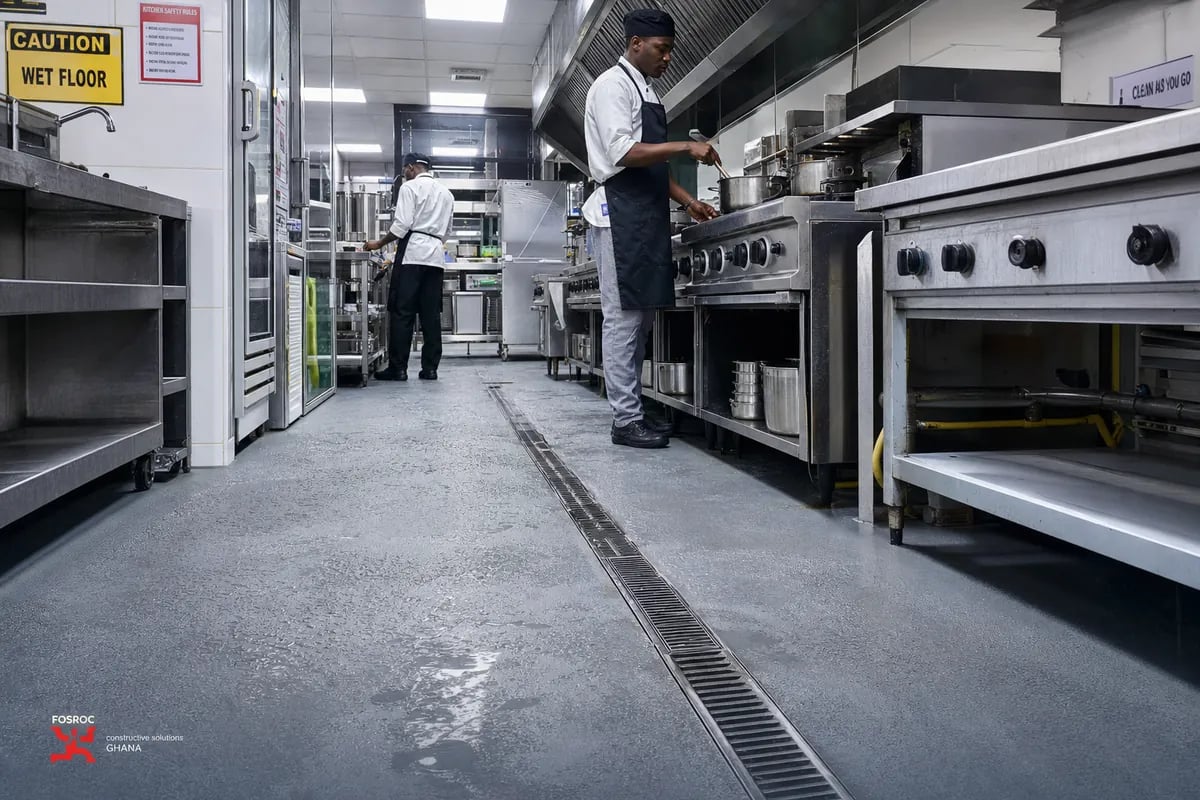
Finish aesthetics are specified to client brief — from natural aggregate textures appropriate to a spa wet room to seamless mid-sheen surfaces suited to a hotel corridor or commercial kitchen. The antimicrobial topcoat is colour-stable under UV exposure and chemical wash cycles, maintaining specification-grade appearance through the operational life of the facility.
Material + System Specification
- Slip rating: R10–R13 classification; friction coefficient verified per ASTM C1028 under wet test conditions, documented and provided to client on project close
- Antimicrobial topcoat: Additive package effective against gram-negative bacteria and common pool-environment fungal species; integrated into topcoat layer — not a surface treatment
- Substrate preparation: ICRI CSP 3–5 mechanical profile; moisture vapour emission assessed and managed prior to primer application
- Drainage integration: Falls engineered at screed or skim-coat stage; minimum 1:80 fall to drain across all wet-zone bays
- Chemical resistance: System rated for continuous exposure to pool chemicals, caustic cleaning agents, and food-safe sanitisers used in commercial kitchen corridors
- Finish options: Aggregate broadcast, trowel-applied texture, or seamless mid-sheen — specified to brief and sector
Typical Project Profile
Wet-zone anti-slip installations typically encompass 120–800 square metres across pool surrounds, spa wet rooms, changing facilities, hotel shower decks, commercial kitchen corridors, and healthcare wet-room suites. Preparation and installation cycles run 5–12 working days depending on substrate condition and system complexity, with phased handover available for live hospitality or healthcare facilities where full-area shutdown is not operationally viable. Sectors served include premier hospitality groups, private hospitals and wellness facilities, institutional sports complexes, and food manufacturing environments.
Outcomes
- Documented R10–R13 slip rating delivered on every installation, with ASTM C1028 test records provided at project close
- Elimination of grout lines and tile joints removes the primary bacterial reservoir in wet-zone floor systems
- Drainage fall integration reduces standing water and extends the effective service life of the coating system
- Seamless antimicrobial surface supports compliance with hospitality, healthcare, and food-safety hygiene protocols
- Finish specification maintained through aggressive cleaning cycles and tropical humidity without delamination or colour degradation