
Le problème
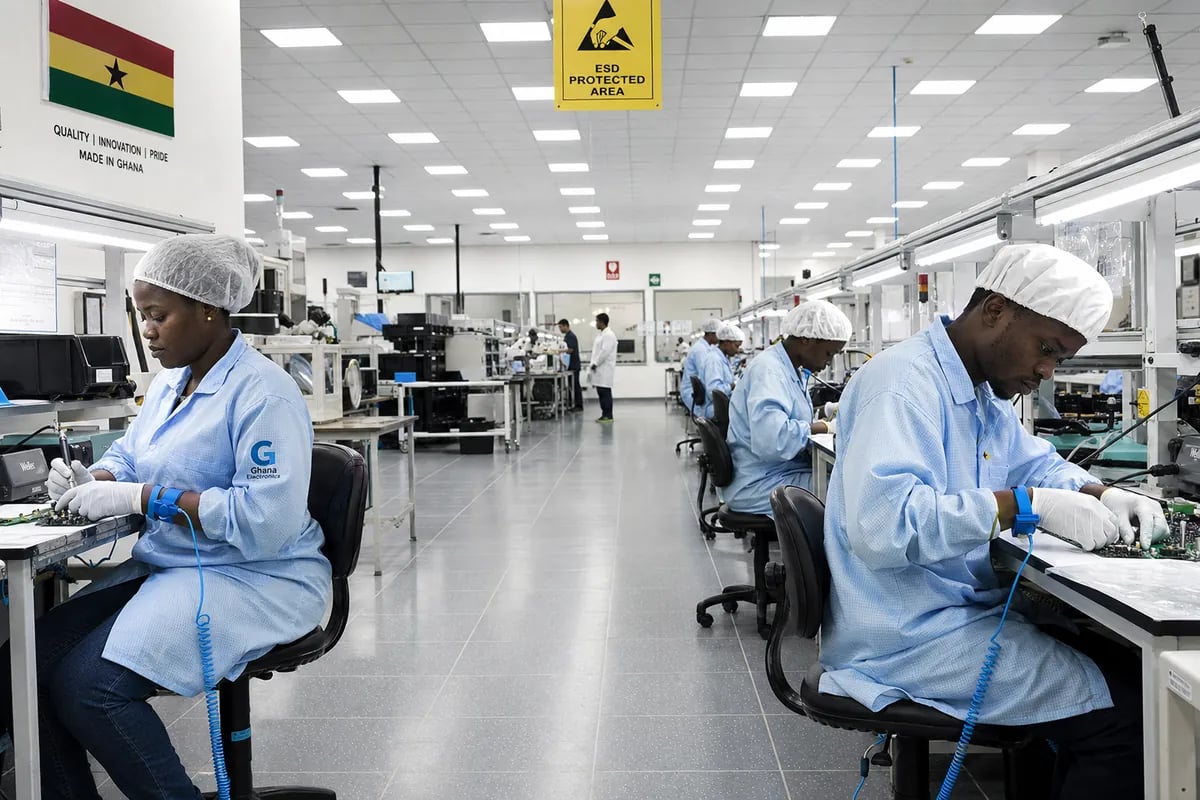
Electronics manufacturing and pharmaceutical-cleanroom environments require ESD-controlled flooring with documented IEC 61340-5-1 compliance.
Notre approche
Epoxy GH delivers IEC 61340-5-1 compliant ESD systems with copper grounding network, conductive primer, continuity-tested topcoat.
Epoxy GH delivers IEC 61340-5-1 compliant ESD systems with copper grounding network, conductive primer, continuity-tested topcoat.
The Challenge
Electrostatic discharge is invisible, instantaneous, and catastrophic in the wrong environment. A single unmanaged static event can destroy a semiconductive component worth thousands of dollars, corrupt a batch of pharmaceutical product, or trigger an ignition in a solvent-handling facility. For electronics assembly floors, cleanrooms, and precision manufacturing environments operating across Accra and greater Ghana, the floor beneath a technician’s feet is not a passive surface — it is an active participant in the electrostatic control system.
Conventional floor coatings are wholly unsuitable for these environments. Standard epoxy, ceramic tile, and vinyl sheet lack the controlled resistivity required by IEC 61340-5-1, the internationally recognised benchmark governing electrostatic protective areas. Without a correctly specified ESD floor system — one that provides a verified, continuous dissipative path from personnel and equipment to a copper grounding network — facilities expose their operations to latent device damage, yield loss, and regulatory non-compliance that auditors will not overlook.
The technical complexity compounds further in Ghana’s high-humidity coastal climate. Resistivity values shift with ambient moisture. Grounding continuity must be engineered from substrate to topcoat, not assumed. Any ESD flooring specification that ignores local environmental conditions is a liability dressed in institutional language.
The Epoxy GH Solution
Epoxy GH’s ESD floor system is engineered from the substrate outward, following a methodology developed across 45 years of precision-environment floor specification. The system begins with a copper grounding network — gridded and bonded to building earth — installed directly onto the prepared concrete substrate. Every layer that follows is formulated to work within that controlled resistive pathway, not around it.
A conductive primer coat follows, penetrating the substrate profile and establishing the first measurable point of the dissipative chain. The body coat and topcoat are then applied in controlled thicknesses, each selected to deliver a surface resistance in the 1 × 10⁶ to 1 × 10⁹ ohm range — the precise window defined by IEC 61340-5-1 for ESD protective floors. Every completed installation receives formal continuity testing using calibrated instruments, with documented point-to-point resistance readings provided to the client facility’s EHS and quality teams.
The result is a floor that passes international audit, supports cleanroom gowning protocols, withstands forklift and trolley traffic, and integrates visually with the specification-grade aesthetic that Tier-1 facilities demand.
Material + System Specification
- Copper grounding grid — 25 mm copper tape bonded to building earth at specified intervals, installed prior to primer application
- ESD conductive primer — two-component epoxy, 80–100 µm DFT, surface resistance ≤ 1 × 10⁴ ohms, ensures continuous dissipative bridge between substrate and body coat
- ESD dissipative body coat — two-component epoxy, 300–500 µm DFT, carbon-loaded formulation, calibrated to IEC 61340-5-1 resistivity window
- ESD continuity-tested topcoat — chemical-resistant, low-particle-shedding finish suitable for cleanroom classifications ISO 7 and above
- Point-to-point resistance documentation — full ANSI/ESD S7.1 test protocol, signed and submitted as project close-out deliverable
- Optional coved skirting — seamless floor-to-wall transition eliminating particle trap zones in pharmaceutical and semiconductor environments
Typical Project Profile
ESD floor installations delivered by Epoxy GH typically span 500 to 8,000 square metres across electronics assembly halls, PCB manufacturing facilities, pharmaceutical cleanrooms, avionics maintenance bays, and data centre raised-floor voids. Project timelines from substrate preparation to final resistance certification range from five to eighteen working days, depending on area and cure scheduling. Sectors served include semiconductor distribution, contract electronics manufacturing, regulated pharmaceutical production, and precision laboratory environments operating under international quality management frameworks.
Outcomes
- Full IEC 61340-5-1 compliance, supported by documented resistance test certificates acceptable to international quality auditors
- Elimination of latent ESD damage events across assembly and testing zones
- Measurable reduction in yield loss attributable to uncontrolled static discharge
- A specification-grade floor surface that withstands industrial traffic while maintaining dissipative performance across the facility’s operational lifespan
- Client EHS and quality teams receive complete installation documentation, enabling seamless integration into existing ISO 9001 and GMP quality records