
Le problème
Existing concrete substrates frequently fail moisture, levelness, or surface-profile specification — coatings on inadequate substrate guarantee premature failure.
Notre approche
Epoxy GH provides specification-grade substrate engineering — ASTM F2170 moisture verification, ICRI CSP profile, self-levelling correction, structural concrete repair.
Epoxy GH provides specification-grade substrate engineering — ASTM F2170 moisture verification, ICRI CSP profile, self-levelling correction, structural concrete repair.
The Challenge
Every specification-grade epoxy system is only as durable as the substrate it rests upon. Concrete floors arrive at the finishing stage carrying a range of latent liabilities — residual moisture trapped below the slab surface, carbonated laitance from inadequate curing, surface profiles too smooth to permit mechanical bond, and historic cracks that, left unaddressed, propagate upward through any applied system within months. In high-throughput facilities — pharmaceutical manufacturing plants, Tier-1 bank operations floors, logistics hubs, and institutional kitchens — this failure mode is not a theoretical risk. It is a documented pattern.
The consequences extend beyond aesthetics. Delaminated epoxy in a pharmaceutical facility triggers regulatory non-compliance. A failed joint in a cold-store floor creates a hygiene breach. A disbonded coating in a data centre raised-floor zone introduces particulate contamination risk. The substrate is not a preliminary step — it is the technical foundation upon which performance guarantees rest.
Ghana’s built environment presents compounding variables: high ambient humidity accelerating in-slab moisture readings, concrete mixes that vary materially from project to project, and construction schedules that consistently compress the curing window. Substrate engineering in this context demands rigorous verification, not assumption.
The Epoxy GH Solution
Epoxy GH applies a structured substrate engineering protocol before any coating or topping system is committed to the slab. The sequence begins with ASTM F2170-compliant in-situ relative humidity testing using calibrated probe arrays — not surface-only readings, which routinely understate moisture conditions by a significant margin. Readings are recorded, mapped, and presented to the project team prior to any material selection decisions.
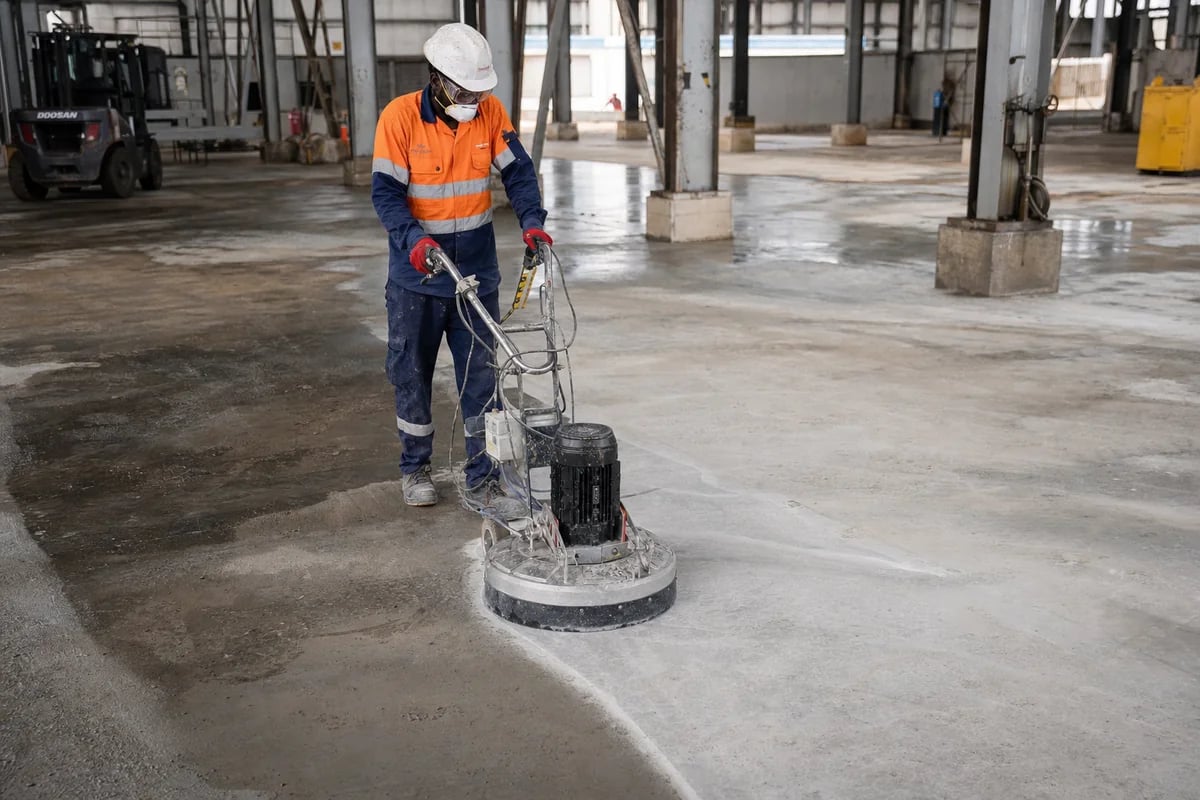
Surface profile is then assessed and corrected to the ICRI CSP (Concrete Surface Profile) specification appropriate to the intended system — typically CSP 3 to CSP 5 for medium-build and heavy-duty epoxy applications. Diamond grinding and shot-blasting are deployed based on surface condition, not as a default. Where structural defects are identified — cracks, spalls, honeycombing, or compressive weakness — proprietary cementitious repair mortars and flexible crack-bridging compounds are applied under specification, with compressive strengths matched to the overlay system above.
Self-levelling cementitious underlayments correct floor-flatness deviations prior to topcoat application, ensuring that the finished epoxy surface meets F-number tolerances required by the client brief. The result is a substrate that is chemically prepared, mechanically profiled, moisture-verified, and geometrically corrected — ready to receive and retain the performance system above it.
Material + System Specification
- Moisture verification: ASTM F2170 in-situ RH probe testing, multi-point mapping, recorded data output
- Surface profiling: ICRI CSP 3–5 achieved via diamond grinding or shot-blasting, selected by substrate condition
- Structural repair: Cementitious polymer-modified repair mortars; compressive strength ≥ 40 MPa, compatible with epoxy overlay systems
- Crack treatment: Semi-flexible polyurethane injection or epoxy crack-lock, depending on crack classification (dormant vs. active)
- Levelling underlayment: Self-levelling cementitious compound, 2–30 mm application range, F-number corrected finish
- Primer interface: Penetrating epoxy primer applied to verified substrate to establish chemical bond and suppress residual moisture transmission
Typical Project Profile
Substrate engineering engagements typically run 3 to 7 working days ahead of the primary epoxy system installation, depending on slab area, defect density, and moisture readings. Epoxy GH executes this scope across pharmaceutical manufacturing facilities, hospital and clinical environments, Tier-1 commercial office fit-outs, food-grade production plants, and institutional logistics centres. Slab areas from 500 m² to 12,000 m² are within standard operational range. Substrate reports, photographic documentation, and moisture data logs are issued as a project record deliverable on all institutional engagements.
Outcomes
- Mechanical bond integrity verified prior to topcoat application — disbondment risk substantially reduced
- Moisture-related delamination eliminated through ASTM F2170 protocol compliance
- Floor-flatness corrected to specification, ensuring consistent aesthetic and functional performance across the finished system
- Structural defects remediated to load-bearing specification before any overlay is applied
- Full substrate documentation record delivered — supporting client QA, facility management, and warranty compliance